


AI-Driven Healthcare: The 2026 Clinical Breakthrough
Technology continues to evolve at an extraordinary pace. AI in healthcare has moved from concept to clinical reality. Across hospitals, clinics, and digital health systems, AI now enhances diagnostics, refines predictive analytics, enables personalized treatment, and streamlines hospital workflows, reshaping the very fabric of care delivery.
Building on this transformation, SUJA is driving an AI-powered healthcare ecosystem founded on trust, precision, and interoperability — empowering doctors with sharper insights and patients with stronger protection.
How AI is Powering Healthcare in 2025
AI in healthcare has evolved from pilot projects to fully functional systems integrated across the care continuum. The focus has shifted from “Can AI help doctors?” to “How efficiently can it support them while maintaining clinical precision and patient trust?”
Hospitals now use AI healthcare innovations across the full spectrum, from AI-powered medical imaging and clinical decision support systems to predictive analytics in healthcare. Generative AI in healthcare is shaping clinical documentation, AI diagnostics are redefining accuracy benchmarks, and predictive models are flagging potential health risks even before symptoms appear.
By 2026, AI in healthcare will stand as a core clinical enabler rather than an emerging innovation. What comes next will be even more transformative, connecting every layer of care into one intelligent, responsive ecosystem. According to recent healthcare AI trends, the global AI healthcare market is expected to surpass $200 billion by 2030, with the largest investments flowing into diagnostics, administrative automation, and generative AI applications in healthcare.
AI Diagnostics: Redefining Precision
One of the most transformative areas of artificial intelligence in healthcare is diagnostics. In 2025, Comparison of AI diagnostics and traditional diagnostics is no longer a debate, it’s a comparison of speed, scale, and precision.
AI-powered diagnostic models now analyze radiology images, pathology slides, and genomic data with accuracy levels exceeding human capability in certain areas. AI medical imaging tools can detect microcalcifications in mammograms or early-stage lung nodules invisible to the human eye. Similarly, in pathology, AI systems can process thousands of slides in minutes, identifying malignant patterns with consistent precision.
This doesn’t replace clinicians, it augments them. The new paradigm is AI for clinical decision support, where doctors leverage AI-generated insights to confirm, not replace, human judgment.
For SUJA, which has long believed in bridging technology and clinical intelligence, these innovations represent the foundation of the next phase of care.
Generative AI in Healthcare: The New Frontier
2025 is the year of Generative AI in healthcare. Its most visible impact? Clinical documentation.
Traditionally, clinicians spend nearly 40% of their time on paperwork, updating electronic medical records (EMRs), documenting visits, and coding for billing. How generative AI is changing clinical documentation in 2025; ambient listening tools transcribe consultations in real-time, summarize patient encounters, and auto-update electronic health records (EMRs) using AI.
This automation has a measurable impact on reducing clinician burnout in hospitals, one of healthcare’s most pressing challenges. Doctors reclaim valuable time for patient interaction, and administrative errors drop significantly.
Generative AI additionally powers AI for patient engagement, chatbots that explain medication routines, track symptoms, or help schedule follow-ups. These conversational AI systems are not just convenient; they humanize digital care, ensuring that technology complements empathy.
SUJA envisions a future where Generative AI applications in healthcare serve as intelligent clinical assistants empathetic, secure, and seamlessly integrated into hospital information systems.
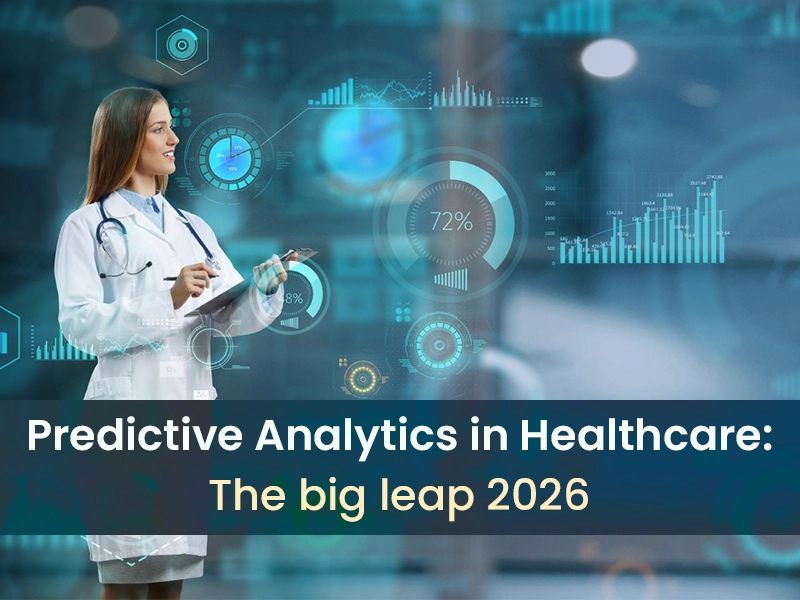
Predictive Analytics in Healthcare: The big leap 2026
The next big leap for AI in healthcare is all about foresight —anticipating diseases, predicting patient outcomes, and guiding preventive care before problems even arise.
The use of predictive analytics for disease prevention in healthcare is helping clinicians shift from reactive care to proactive wellness. Early-warning AI systems are flagging patients at risk of cardiac arrest, diabetic complications, or sepsis hours before critical onset.
This kind of healthcare data analytics relies on deep learning models that continuously refine themselves through new data. Hospitals now use AI in healthcare administration to anticipate patient inflow, optimize staffing, and allocate ICU beds dynamically based on predicted needs.
By integrating predictive analytics with remote patient monitoring tools, care teams can track vitals, detect anomalies, and intervene before emergencies occur. SUJA believes that predictive intelligence coupled with remote care, will define the next generation of digital health transformation.
AI in Hospital Workflow Automation
While AI diagnostics and predictive analytics are redefining patient care, AI in hospital workflow is making quieter reorganizations. Administrative processes: billing, scheduling, discharge planning, and insurance preauthorization, are now largely AI-driven.
These systems analyze operational data in real time, reducing delays and improving transparency. With clinical documentation automation and AI-powered task management, hospitals are achieving significant gains in operational efficiency.
SUJA’s Careaxes hospital management software, for instance, leverages AI-driven modules that synchronize departments from pharmacy to radiology ensuring that data flows seamlessly without duplication or human lag.
This automation doesn’t just save costs; it drives total system intelligence, hospitals that think, adapt, and optimize themselves dynamically.
AI for Patient Engagement and Support
The role of AI chatbots in patient engagement and support has expanded far beyond appointment reminders. In 2025, AI-powered patient apps provide mental health support, chronic disease coaching, and medication adherence tracking.
Patients can chat with AI systems trained on medical datasets that provide context-aware, evidence-based responses. The fusion of AI and human support is resulting in better treatment adherence, improved patient satisfaction, and enhanced care continuity.
SUJA’s vision aligns closely creating AI-driven patient engagement layers that are personalized, multilingual, and compliant with regional health regulations. Because engagement isn’t about technology; it’s about trust and empowerment.
AI in Drug Discovery and Personalized Medicine
Another frontier where machine learning in healthcare shines is drug discovery. AI algorithms now simulate molecular interactions at lightning speed, drastically reducing the time from research to clinical trials.
AI in drug discovery is enabling pharma companies to repurpose existing drugs, design new compounds, and identify novel biomarkers for targeted therapies. Combined with personalized medicine approaches, patients can now receive treatments designed for their genetic makeup, not the average genome.
This convergence of AI, genomics, and pharmacology will unlock the next decade of precision healthcare where medicine is no longer generalized but deeply individualized.
Regulatory and Ethical Challenges: Trust Is the New Benchmark
The promise of AI in healthcare in 2026 will come with its own challenges. As AI systems handle massive volumes of sensitive data, concerns around healthcare data privacy and regulatory compliance for healthcare AI are paramount.
Governments worldwide are tightening frameworks to ensure transparency, explainability, and fairness in healthcare AI models. Patients and providers want to understand how decisions are made, not just what the AI concludes.
What are the regulatory challenges for AI in healthcare 2025? The list includes data localization, algorithmic bias, interoperability standards, and accountability for clinical outcomes.
SUJA advocates for a “Trust by Design” model — where every AI deployment in healthcare must be explainable, ethical, and auditable and future ready. In this vision, technology and compliance are not adversaries but collaborators in safeguarding patient dignity.
The Road Ahead: SUJA’s Vision for AI-Driven Healthcare
For SUJA, the journey toward AI in healthcare 2026 is about purpose-driven innovation.
Our platforms embrace AI diagnostics, predictive analytics, hospital automation, and patient engagement systems, all woven into a secure, interoperable fabric that aligns with clinical workflows.
Looking ahead, SUJA sees healthcare AI trends evolving around three key dimensions:
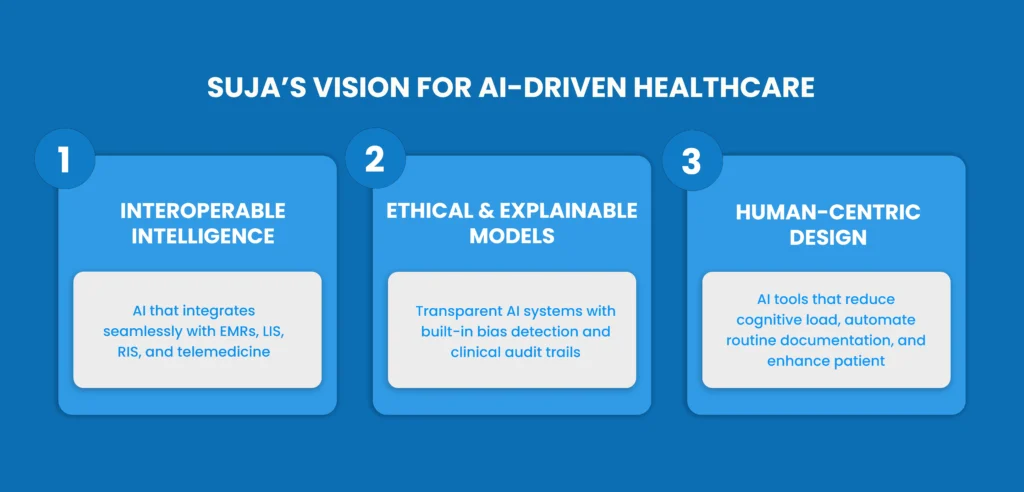
- Interoperable Intelligence: AI that integrates seamlessly with EMRs, LIS, RIS, and telemedicine platforms.
- Ethical and Explainable Models: Transparent AI systems with built-in bias detection and clinical audit trails.
- Human-Centric Design: AI tools that reduce cognitive load, automate routine documentation, and enhance patient communication.
The future SUJA envisions is about AI creating a symphony of intelligence; where algorithms, clinicians, and patients collaborate to deliver care that is faster, safer, and profoundly more human.
AI in healthcare 2026 stands at the intersection of science and empathy. As artificial intelligence in medicine matures, it promises not just better diagnostics or faster workflows, but a redefinition of what healthcare feels like personal, proactive, and precise.
From AI diagnostics 2025 to predictive analytics healthcare 2026, from generative AI in clinical documentation to AI-powered patient engagement, the ecosystem is evolving rapidly. But true innovation does not only rest on technology alone, but how we apply it responsibly.
Discover how AI will reshape healthcare in 2026 with smarter diagnostics, hospital management software, faster workflows , and predictive patient care.