


Category
Gyneye InsightsDate Posted
October 7, 2022Bridging screening gaps with Gyneye colposcopy
Early detection of cervical cancer can reduce mortality to a great extent. Unlike most other types of cancer, cervical cancer is preventable when precursor lesions are detected and treated early. Cervical cancer is totally avoidable not only because the definitive cause of cervical cancer is now known, but also because the disease takes a longer time to develop after initial infection with high-risk Human papillomavirus (HPV) in most cases. Early diagnosis of cervical cancer through regular cervical screening devices and AI-powered screening tools can significantly reduce both the incidence and mortality of cervical cancer.
Bridging the gap in cervical cancer care: Tackling barriers to screening, follow-up, and treatment access
It is estimated that over 311,000 women globally die from cervical cancer every year and nearly 84% of these deaths occur in low and middle-income countries of the world. Besides the need for a cost-effective and portable cervical screening device, any program must also consider the societal realities for women living in communities while accessing healthcare services. Community cervical screening camps face major roadblocks during follow-up evaluations and treatment. Women who attend gynecology screening largely remain untraceable primarily due to reasons related to childcare issues, cost of traveling, commuting long distances – or often due to unwarranted reasons such as the need to seek permission from the male partner, fear of cancer, deep-rooted stigma, and prejudices.
The low-cost Visual Inspection with Acetic Acid (VIA) remains a preferred choice in such regions where costs are a huge barrier to healthcare. But again, this remains a poor triage due to the dependency on the experience of those performing the colposcopy procedure. HPV is the gold standard for cervical pre-cancer detection and cancer screening; however, the method requires high capital investments, trained professionals, and is complex. Hence, there exists an urgent need for a triage test that is reliable, low-cost, and easy to use — a true preventive healthcare device for women’s health technology via digital colposcope in India.
Advancing affordable, AI-Powered cervical screening device for women’s health
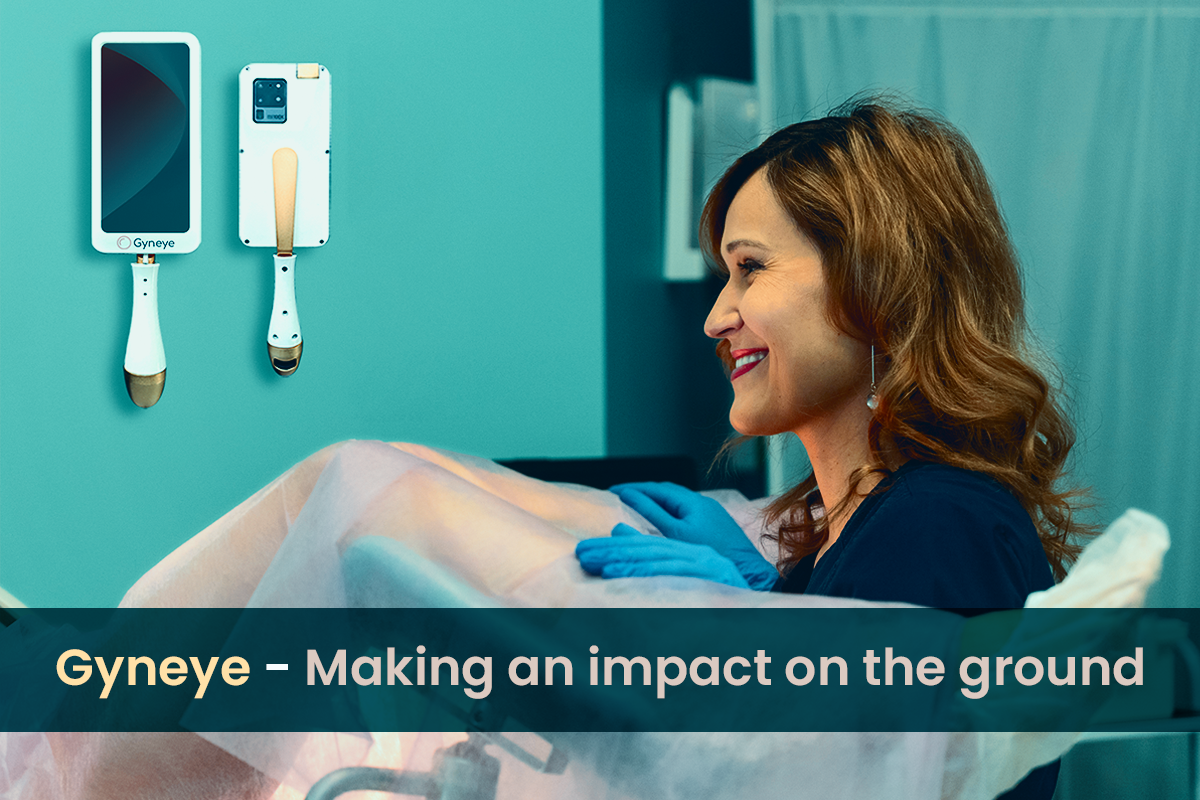
Gyneye Smart Colposcope, a next-generation AI colposcope, provides a complete digital cervical visualization. Gyneye offers the highest level of AI cervical screening with its state-of-the-art, CE-certified, hand-held and portable digital colposcope, developed with over two decades of field experience globally. It is specifically designed to work in the lowest resource settings across India and other developing countries, with localized multi-lingual support.
Gyneye’s handheld cervical screening device application integration with telemedicine screening tools addresses screening gaps and makes it easy and effective for virtual consultations with cervical cancer specialists from remote locations. The integration empowers the field team to deliver quickly and credibly by offering a single-window approach for cervical cancer screening in India. Using the VIA technique, Gyneye allows users to capture high-resolution digital images of the cervix and automatically assigns a SWEDE score to assess the risk of cancer.
Redefining cervical screening with AI precision, portability, and digital integration
Our study has shown that SWEDE scores obtained by trained healthcare workers using this AI cervical detection device for hospitals could offer an accurate cervical diagnosis comparable to expert evaluations. Gyneye, recognized as one of the best AI colposcopes in India, envisions using Artificial Intelligence in women’s health as a tool to reduce the dependency on expert gynecologists and enable faster diagnosis in both hospital and field settings.
This portable cervical screening device for clinics provides a simple, effective, and flexible means to conduct colposcopic examinations and risk assessments of cervical cancer. The diagnostic quality is comparable to traditional colposcopes but is much easier to use, implement, and maintain. The workflow is designed to capture patient information, obtain consent, record history, conduct an examination, and document findings digitally. Each image captured can be reviewed before saving to the patient’s record — making Gyneye a complete digital healthcare innovation and an affordable colposcope for doctors working in both urban and rural environments.
In summary, Gyneye is not just a gynecology imaging solution — it’s a breakthrough in AI-powered cervical screening technology (2025) that’s reshaping how doctors detect, document, and manage cervical health. With AI in women’s health and telemedicine integration, Gyneye bridges the gap between accessibility and accuracy, empowering clinicians to perform cervical lesion detection and early diagnosis of cervical cancer with unmatched precision and affordability.
Gyneye: empowering early cervical cancer detection through AI, portability, and connected digital colposcopy
Cervical cancer remains a major public-health challenge in India: the country sees tens of thousands of new cases each year, and screening programmes face obstacles of infrastructure, specialist availability, cost and logistics. Traditional methods like Pap smear or visual inspection with acetic acid (VIA) are useful but have limitations in accuracy and logistics, especially in low-resource and remote settings.
In 2025 the evolving cervical-screening technology landscape emphasises portable digital colposcopes equipped with high-resolution imaging, tele-medicine connectivity and AI-assisted interpretation. These devices aim to bring specialist-level diagnostic capability into clinics, outreach camps and primary health settings, making triage faster, more accurate and accessible.
Gyneye stands out as a relevant example in India. Its smart, handheld digital colposcope is CE-certified and designed for portability and ease-of-use in clinics and outreach camps. Key features include high-resolution imaging of the cervix, built-in workflow for patient-data capture, annotation, integration with EMR (electronic medical-records) systems, and telemedicine/referral modules for specialist backup.
Importantly, Gyneye’s AI-module supports colposcopy interpretation: it assists in locating biopsy sites, recognising abnormal cervical patterns, and thereby reduces dependence on senior specialists in outreach or rural settings. The device also supports risk-scoring (e.g., SWEDE score) for triage, enabling faster decision-making.
Gyneye has been deployed in community screening programs, mobile platforms, tele-health setups and private clinics alike. It is enhancing access, reducing screen-to-diagnosis delay, empowering paramedical staff and improving documentation. By making high-quality cervical imaging and AI-assisted interpretation available in non-metropolitan settings, Gyneye is helping to close the gap between screening and timely intervention—thereby contributing to the goal of early detection and better outcomes in cervical cancer care.